From Prototype to Serial Production: Combining 3D Printing and Injection Moulding
Many new products start with a simple challenge: how to quickly validate a design, test functionality, and bring a product to market without investing in expensive tooling too early. This is where additive manufacturing (3D printing) becomes an excellent solution.
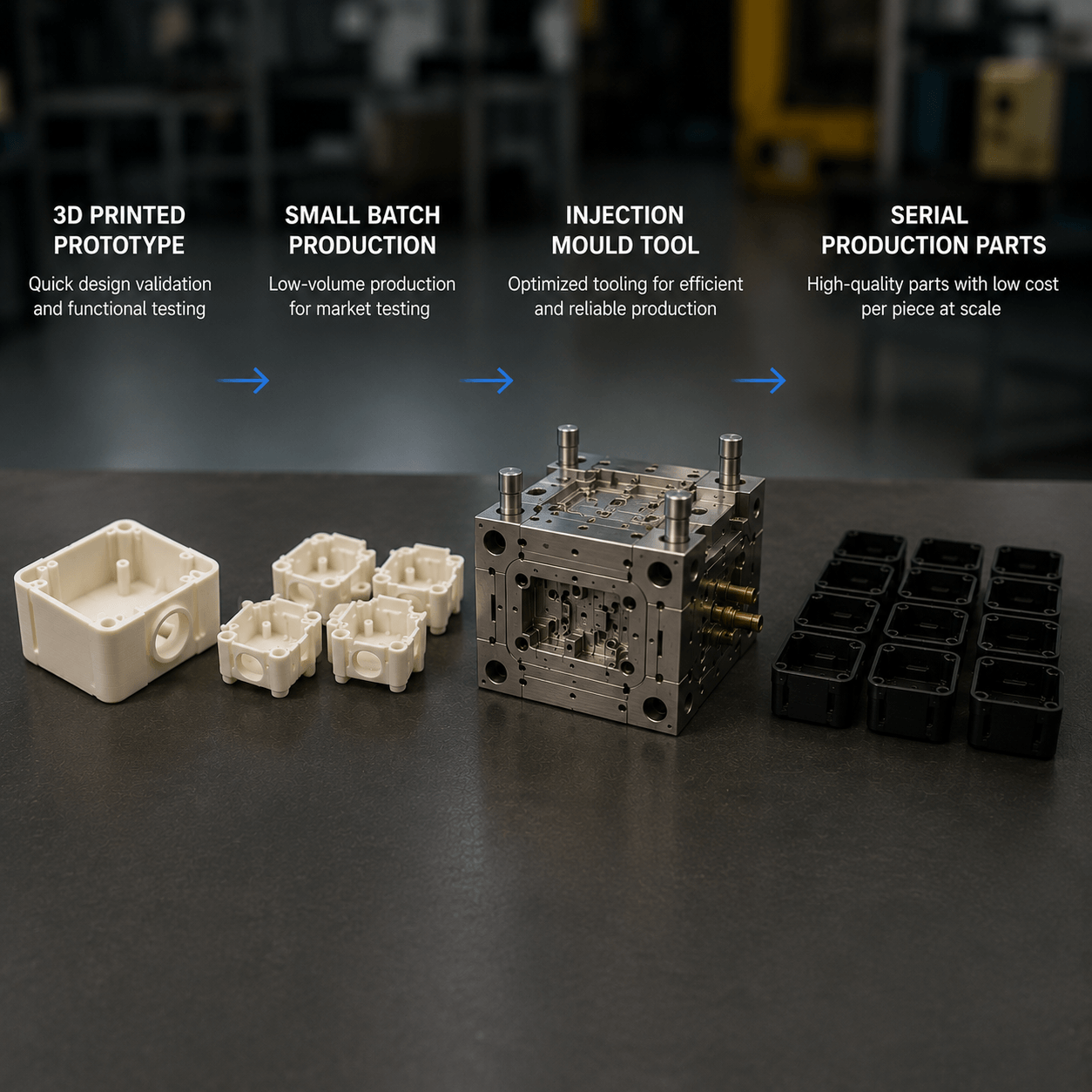
At Plastit, we support customers throughout the entire product lifecycle – from early prototypes and small production batches to serial injection moulding production.

1. Phase: Rapid Prototyping and Design Validation
When a product is still in its early stages, 3D printing provides the perfect tool to test form, fit, and function. Depending on your project's specific requirements, Plastit utilizes two core technologies:
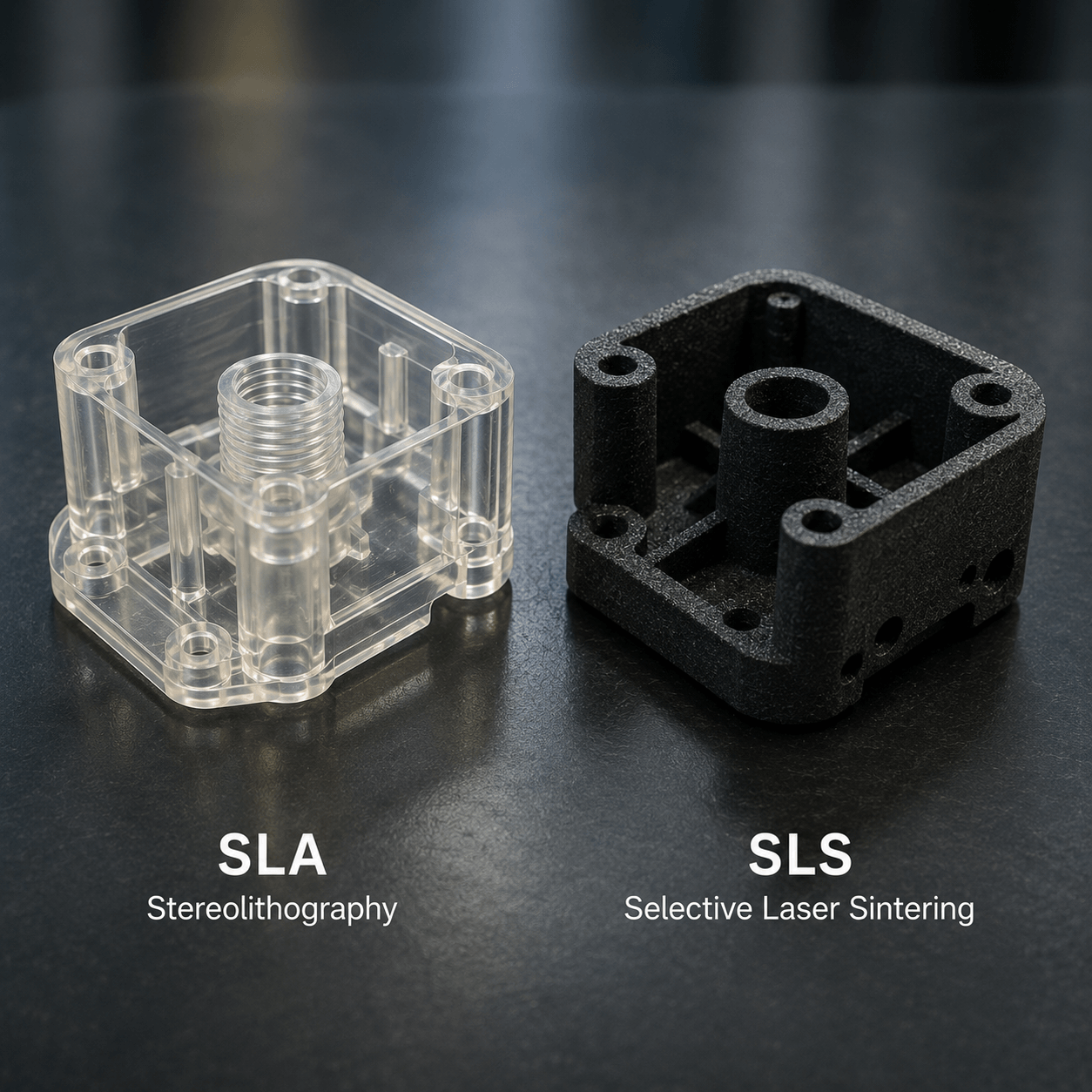
SLA (Stereolithography)
SLA technology uses a UV laser to selectively cure liquid photopolymer resin layer by layer.
- Benefits: Excellent surface quality, fine details, and high dimensional accuracy.
- Ideal for: Visual prototypes, design validation, housings, covers, and presentation models.
- Materials: Rigid resins, tough engineering resins, flexible materials, transparent materials, and high-temperature materials.
SLS (Selective Laser Sintering)
SLS technology uses a laser to selectively fuse polymer powder layer by layer. Unlike SLA, support structures are not required, allowing highly complex geometries and excellent mechanical performance.
- Benefits: Enables highly complex geometries and provides excellent mechanical performance.
- Ideal for: Functional testing, durable parts, and low-volume production batches.
- Materials: PA12, PA11, glass-filled nylon, carbon-filled materials, and TPU.
SLA vs SLS Comparison
| Feature |
SLA |
SLS |
| Surface quality |
Excellent |
Good |
| Dimensional accuracy |
Excellent |
Very good |
| Mechanical strength |
Moderate |
Excellent |
| Visual appearance |
Excellent |
Moderate |
| Complex geometries |
Good |
Excellent |
| Functional testing |
Good |
Excellent |
2. Phase: Designing Today for Tomorrow’s Production
One of Plastit’s key advantages is that we do not view 3D printing as a separate process from serial production. Whenever possible, we design parts already with future injection moulding requirements in mind.
By considering future manufacturing requirements, such as proper draft angles and wall thickness, already during the development phase, we help customers:
- Reduce redesign work and engineering changes.
- Shorten lead times and simplify tooling development.
- Ensure a faster and seamless transition to serial production when demand increases.
3. Phase: When Does Injection Moulding Become More Economical?
3D printing is an excellent solution for prototypes and low-volume production. However, as annual demand increases, injection moulding often becomes the more economical option.
Key benefits of transitioning to injection moulding:
- Lower part costs at scale.
- Faster production cycles.
- Higher overall production capacity.
For every project, Plastit can calculate the break-even point and help determine when investment into tooling becomes financially justified.
Conclusion: From Concept to Serial Production
By combining engineering support, 3D printing, mould manufacturing, and injection moulding production, Plastit helps customers move efficiently from idea to market-ready product.
Whether you need a single prototype, a pilot production batch, or long-term serial production, we can support every stage of your product journey.
Developing a new product?
Contact us and let us help you find the optimal path from concept to serial manufacturing!
