An injection mould transfer is the structured process of moving an existing injection mould and its serial production to a new manufacturer — including technical assessment, installation, trial production and validation — so that quality, delivery and supply continuity are preserved.
Companies change injection moulding suppliers for many reasons: quality, delivery performance, capacity, cost, communication or supply-chain risk. But moving an existing mould to a new manufacturer raises one central question:
How can you transfer production to a new injection moulding supplier without risking quality problems, delivery delays or production downtime? The answer lies in a structured transfer process, not simply shipping a tool from one factory floor to another.
The new supplier needs to understand the tool, the product, the material, the existing production process and the customer's quality requirements before stable serial production can begin. At Plastit, we support customers throughout the complete production takeover process — from the initial technical assessment and mould transfer to trial production, validation and stable long-term serial production.
1. Why Do Companies Change Injection Moulding Suppliers?
There are many reasons why a company may consider transferring existing injection moulds to another manufacturer:
- inconsistent product quality or increasing scrap rates
- delivery delays
- insufficient production capacity
- poor communication or slow technical support
- increasing production costs
- supplier consolidation
- closure or restructuring of an existing supplier
- long geographical supply chains
- the need to move production closer to the European market
- lack of engineering or process optimisation support
In some cases, the existing injection mould itself may still be perfectly usable — the problem is not necessarily the tool, but the production environment around it. Transferring the existing mould can let the customer improve the supply chain without investing immediately in completely new tooling. However, a successful transfer requires considerably more than simply installing the mould in another injection moulding machine.
2. What Are the Main Risks When Transferring an Injection Mould?
Every injection mould and production process develops its own manufacturing history. Even when the same mould, polymer and product drawing are used, changing the production location can influence the process. Different injection moulding machines may differ in:
- clamping systems
- injection units
- screw diameters
- control systems
- drying equipment
- temperature control units
- automation systems
- cooling conditions
The condition of the mould itself must also be considered. Wear on moving components, cooling channels, ejector systems, hot runners or sealing surfaces may not have caused obvious problems at the previous production location but can become important once the mould is transferred and the process is re-established. For this reason, the transfer should begin with a technical assessment rather than immediate serial production.
3. Technical Assessment Before the Mould Transfer
Before taking over serial production, as much information as possible about the existing process should be collected. Ideally, the transfer package includes:
- mould drawings and technical documentation
- 3D models of the product
- current 2D drawings and tolerances
- material specifications
- existing injection moulding parameters
- cycle time
- mould maintenance history
- quality documentation
- approved reference samples
- information about known production issues
- annual quantities and production forecasts
The mould itself should also be inspected. Depending on the project, the assessment can include the condition of:
- mould cavities and cores
- parting surfaces
- ejector system
- sliders and moving components
- cooling circuits
- hot runner system
- connectors and interfaces
- hydraulic or pneumatic systems
- sensors
- wear components
This inspection helps identify potential maintenance requirements before the tool enters production. The goal is to understand the condition of the mould and the existing process before establishing production at the new location.
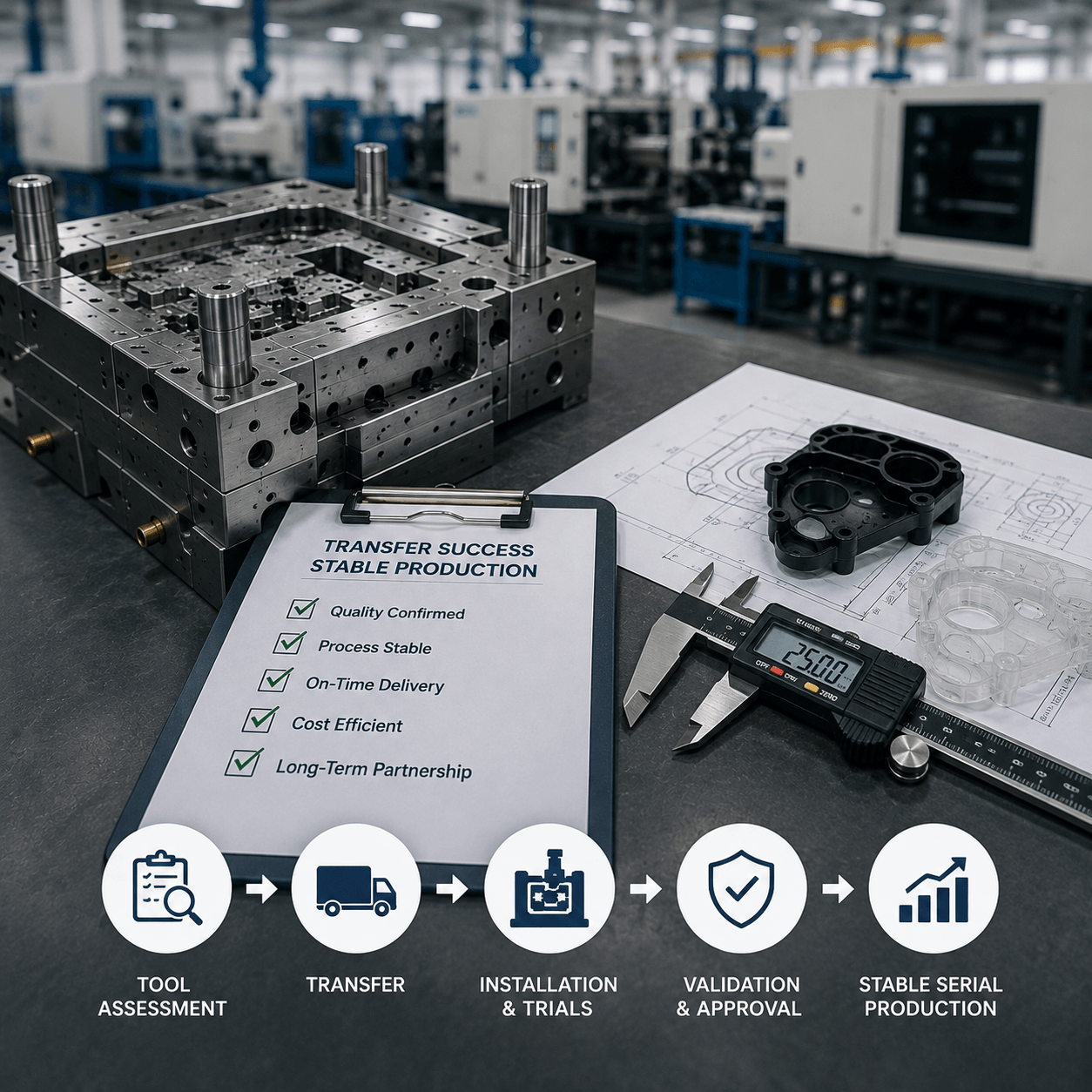
4. Planning the Transfer Without Interrupting Supply
One of the biggest concerns when changing an injection moulding supplier is production continuity. Customers normally cannot simply stop receiving components while the mould is being transferred and validated. A good transfer plan therefore considers the customer's existing stock, consumption rate, transport time, validation requirements and expected production ramp-up. Where possible, sufficient safety stock should be produced before the mould leaves the existing supplier.
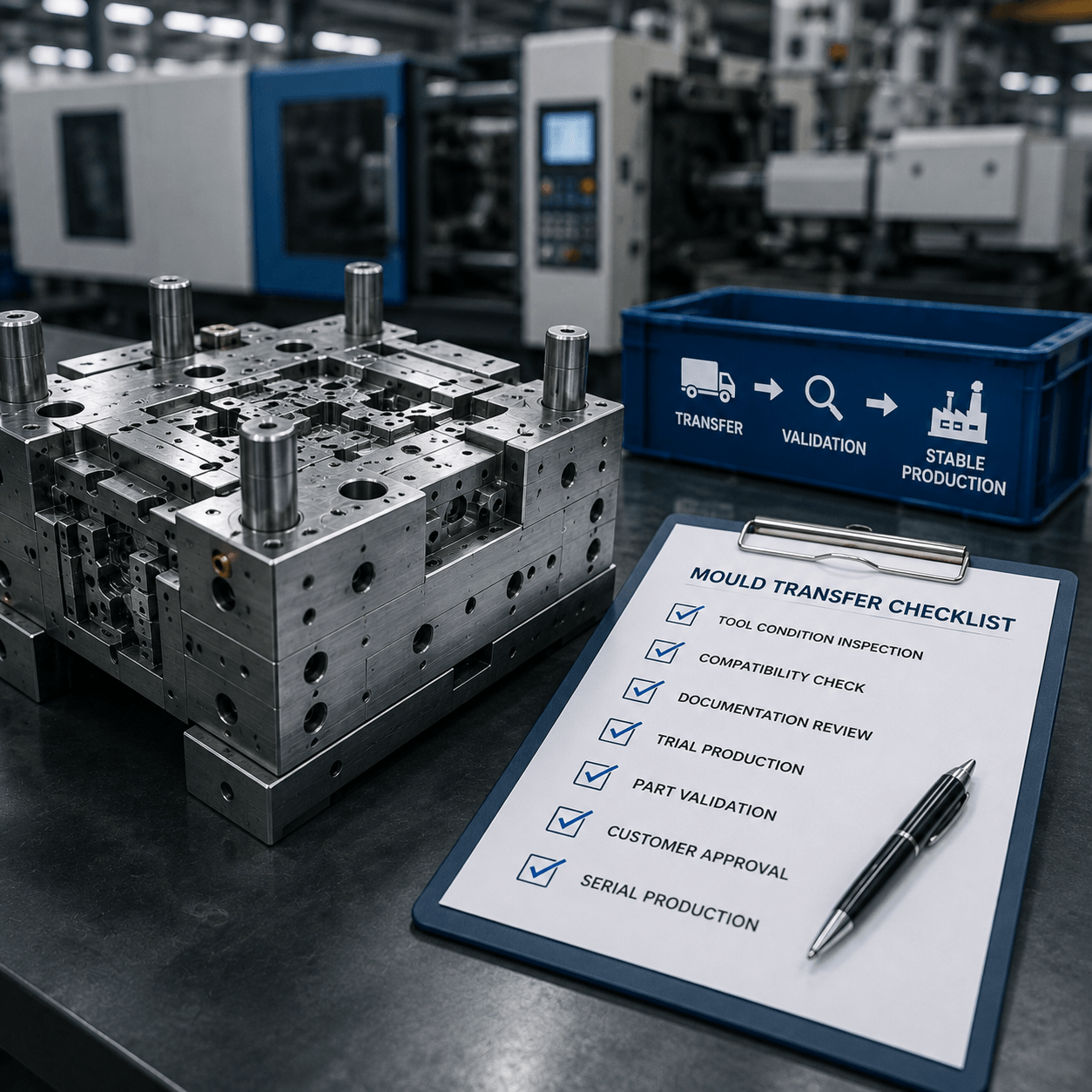
Receive the mould > Inspect it > Install it > Perform trial production > Validate the parts > Receive customer approval > Start serial production
The required safety stock depends on the complexity of the project and the expected transfer time. Planning this stage correctly significantly reduces the risk of supply interruption.
5. Mould Installation and Trial Production
After the mould arrives at the new production facility, it is prepared and installed on a suitable injection moulding machine. The first objective is not to maximise production speed immediately — it is to establish a stable and repeatable process. Existing production parameters provide a valuable starting point, but they may need adjustment because of differences between machines, auxiliary equipment and production environments. During initial trials, important parameters can include:
- melt temperature
- mould temperature
- injection speed
- injection pressure
- holding pressure and time
- cooling time
- screw speed
- back pressure
- total cycle time
The parts produced during the first trials are then compared with the customer's technical and quality requirements.
6. Validation Before Serial Production
A mould transfer is only successful when the product produced at the new location meets the required specifications. Depending on the project and industry, validation may include:
- dimensional inspection
- visual inspection
- functional testing
- material verification
- comparison with approved reference samples
- first article inspection
- process capability studies
- PPAP documentation where required
For automotive and other highly controlled industries, additional customer-specific validation requirements may apply. The purpose of this stage is to verify that the transferred process can repeatedly manufacture components according to specification before regular serial deliveries begin.
7. Production Stabilisation and Process Optimisation
Receiving customer approval is an important milestone, but it should not necessarily be considered the end of the transfer project. Once production is running, the process can be monitored and, where appropriate, further optimised. Potential areas for optimisation include:
- cycle time
- cooling efficiency
- scrap rate
- process stability
- mould maintenance
- automation
- material consumption
- packaging and logistics
The goal is not simply to reproduce the previous production process. Where technically possible, the transfer can also be an opportunity to make the process more stable, efficient and economical — particularly valuable when a customer has experienced recurring quality problems, high scrap rates or inefficient cycle times with the previous supplier.
8. When Does a Mould Need Modification or Repair?
Not every transferred injection mould can immediately enter serial production. Older tools may show wear or may have been modified several times during their lifetime, and documentation may no longer fully correspond to the actual condition of the mould. After inspection and trial production, maintenance or modifications may therefore be recommended. Examples include:
- replacing worn ejector components
- repairing damaged mould surfaces
- cleaning or improving cooling channels
- repairing sliders or guides
- servicing hot runner components
- replacing seals
- correcting venting
- improving cooling
- adapting machine interfaces
If modifications are required, they should be discussed with the customer before implementation. The objective is always the most economical solution: repair the existing mould, modify it, or — in cases of severe wear or changed production requirements — manufacture a new tool.
9. Should You Always Change Your Injection Moulding Supplier?
No. Changing suppliers introduces its own costs and risks. If your current injection moulding supplier consistently provides:
- stable quality
- competitive pricing
- reliable delivery
- sufficient capacity
- good communication
- strong technical support
then transferring production purely for a small difference in part price may not be economically justified. The complete cost of a supplier change should be considered, including transfer, validation, logistics, internal resources and potential production risk. However, if recurring quality problems, delivery failures, insufficient capacity or supply-chain risk are affecting the business, a structured production transfer can provide significant long-term benefits.
10. Transferring Injection Moulding Production to Plastit
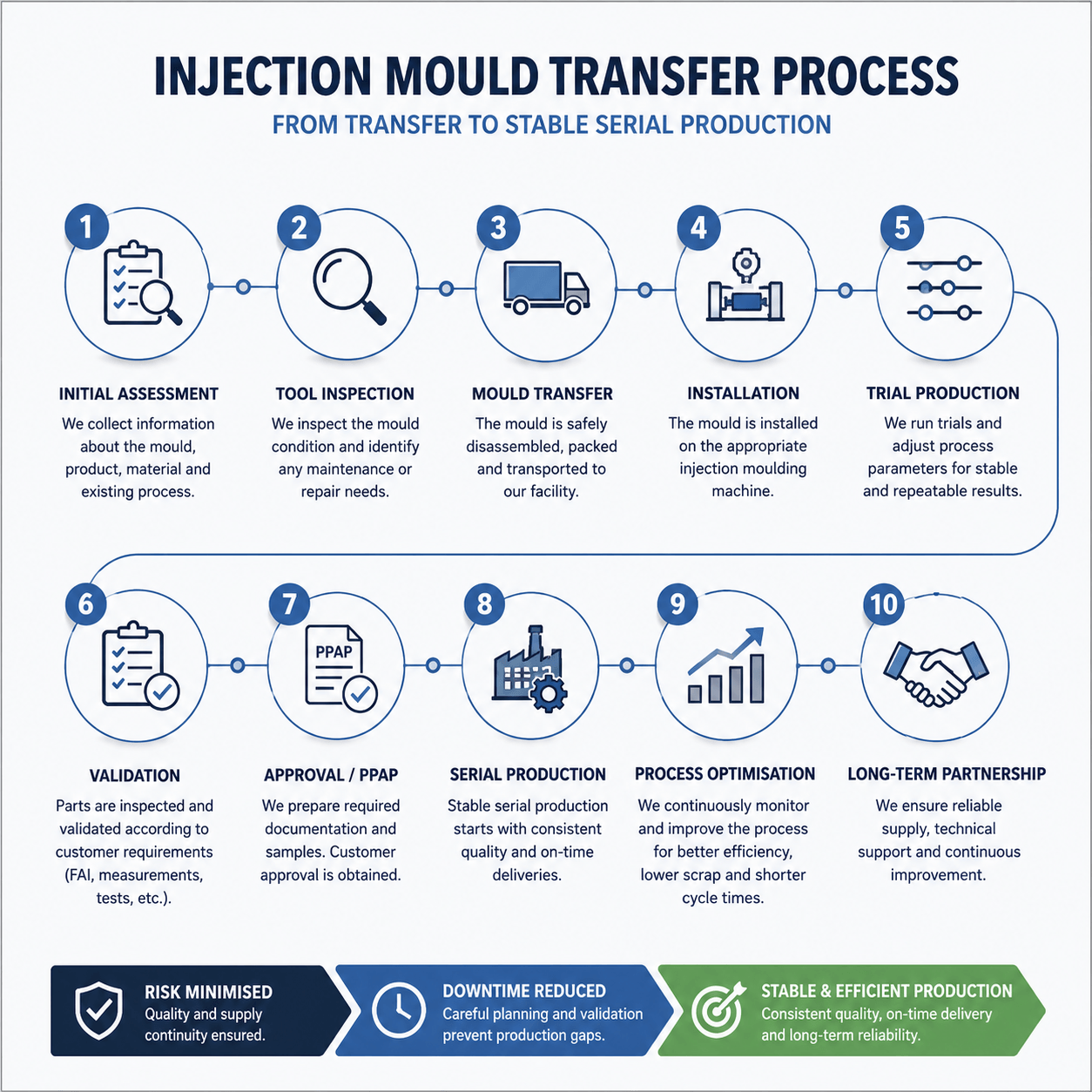
At Plastit, we support the complete takeover of existing injection moulds and serial production. Our approach can include:
Technical assessment > Mould transfer > Tool installation > Trial production > Validation > Customer approval > Serial production > Continuous optimisation
Because mould manufacturing, mould maintenance, injection moulding and engineering support are available within the same production environment, technical issues identified during the transfer can be addressed efficiently. Depending on customer requirements, we can also support first article inspection, dimensional validation and PPAP for automotive projects, along with reliable logistics once serial production is running.
Our objective is not simply to receive an existing mould. Our objective is to establish stable, repeatable and economically efficient long-term production.
Frequently Asked Questions
Can an existing injection mould be transferred to another manufacturer?
Yes. Injection moulds are commonly transferred between manufacturers. Before serial production starts at the new supplier, the mould should be inspected, installed on a suitable machine, tested and the resulting parts validated.
What information is required when transferring an injection mould?
Ideally, the new supplier should receive mould documentation, product drawings and 3D models, material specifications, existing process parameters, approved samples, quality requirements and information about previous production problems. The more complete the information, the easier it is to establish the process at the new production location.
Does an injection mould need to be modified when changing suppliers?
Not necessarily. A mould in good condition may run at the new supplier without significant modification. However, maintenance, repair or adaptation may be required if the tool is worn, damaged or incompatible with the available production equipment.
How is production validated after a mould transfer?
Validation depends on the customer's requirements and can include dimensional inspection, visual and functional testing, first article inspection, capability studies and PPAP where required.
How can production interruption be avoided during a mould transfer?
The transfer should be planned around existing inventory and customer consumption. Producing sufficient safety stock before moving the mould can provide the necessary time for transport, installation, trials, validation and customer approval.
Can Plastit take over moulds manufactured by another toolmaker?
Yes. Existing injection moulds can be evaluated and transferred to Plastit for testing and serial production. The technical condition and compatibility of each mould are assessed as part of the transfer process.
Can Plastit optimise an existing injection moulding process?
Yes. After establishing stable production, the process can be evaluated for potential improvements in cycle time, scrap rate, process stability, cooling, tooling and overall production efficiency.
Does Plastit support PPAP after transferring an injection mould?
Yes, PPAP and the necessary validation activities can be supported for automotive projects according to the project and customer requirements.
Looking for a New Injection Moulding Supplier?
Changing an injection moulding supplier does not have to mean starting again with new tooling. With the right technical assessment, transfer planning and validation process, existing moulds can be successfully integrated into a new production environment while minimising the risk of supply interruption.
If you are considering transferring existing injection moulds or serial production to a European manufacturing partner, send us information about your mould, product and current production requirements. Our engineering team can evaluate the project and propose a structured path from mould transfer to stable serial production.

www.plastit.si